Saturday, 31 January 2015

Wearable Art from Mouflon 2015


IMBOLC ....Celebrate the coming of Spring 


In Ireland, January 31st. is  the festival of Imbolc, which begins the season of Spring.
This festival marks the releasing of winter’s grip on the land.
The name Imbolc is derived from the lactating of the ewes which begin lambing at the end of January.


The ancient peoples celebrated this festival as it was the first dairy produce they had after a long dark winter.

Honoring of the goddess Brigit, daughter of the god Dagda, fell on the first day of February, now also called St. Brigit's Day, after she was adopted as a Christian saint.
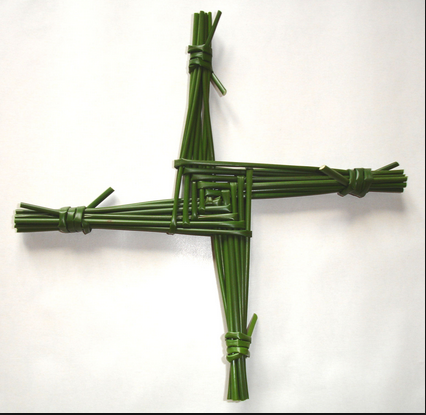


Woven crosses are still made to celebrate this day.


'IMBOLC'  Wearable Art from Mouflon

Imbolc Necklace

Imbolc Earring


Details: The necklace is made from natural silk yarn wrapped on cotton jersey material.Artificial fabric flowers and leaves, wood beads, coloured wire spirals and closed with silver plated hook and ring.
Length end to end: 23.5 cms.
Earrings: Natural silk yarn wrapped on aluminum wire, artificial fabric flowers and leaves, with silver plated hooks.
Length from hook: 4 cms.

For more information about Imbolc....go to.....


Monday, 26 January 2015

Wearable Art 2015

New....Earrings to compliment my wearable art necklaces.

Jardin Majorelle

Inspiration for this design was taken from the Majorelle Gardens in Marrakech, Morocco.

The gardens were created by the french artist Jacques Majorelle in 1924.


 The earrings measure 3.5 cms. from the hooks. They are made from alumnium wire, cotton slubbed yarn, hemp thread and glass beads, the hooks are silver plated and nickle free, ......another unique design from Mouflon.

...more designs on my web site www.uniqueartisanjewellery.com

Sunday, 7 December 2014

Corsets, Crinolines and Codpieces Part 6 Shape Changing

Shape Changing a dictate of Fashion?


Sage Grouse mating display

Birds change their appearance when looking for a mate...is there a parallel to humans and the need to change the shape of their bodies by artificial means. Does fashion dictate an altered body shape?

Shapes seem to change their focus on a regular basis over the centuries with seemingly little thought for the comfort of the wearer.

Padded Front
A portrait of Archduke Charles in a peascod doublet from 1569. Unknown artist
Melon shaped padded trousers
A peas cod belly or Goose belly was a exaggeratedly padded stomach area. This was very popular, mainly in mens dress, in the late 16th and early 17th centuries, and padded trousers 1550-1600.

Adding Height
Venetian courtesan  wearing chopines
 A chopine is a type of women's platform shoe that was popular in the 15th, 16th and 17th centuries, and were popularly worn in Venice by courtesans and were made of wood or cork. Note the padded breeches worn under the skirt. Chopines, besides their practical uses of protecting the foot from irregularly paved and wet or muddy streets, were also a status symbol becoming a  reference to the cultural and social standing of the wearer; the higher the chopine, the higher the status of the wearer. High chopines allowed a woman to tower over others.

 During the 18th century hair was dressed into elaborate
coiffures to give added height to the wearer.

Marie Antoinette by Elizabeth Vigee Le Brun

Hair styles became even more exaggerated with a variety of added decoration all giving extra height to the wearer.
Volume

Queen Elizabeth I ('The Ditchley portrait')
by Marcus Gheeraerts the Younger
1592
 The great farthingale so called because of it large circumference, was fashionable in the 1590's and died out during the mid 17th century when it was mainly worn only at court. The skirt was worn at an angle low in the front and higher behind giving the appearance of a longer torso and consequently shorter legs. The sitting problem seems to have been overcome by seating the wearer on a pile of cushions and spreading the vast skirts around themselves.Probably the nobility had special designed seating, perhaps padded stools. 

The stiffened cone shaped elongated bodice was also a feature of this fashion
 Added Length
German mens shoes 1550
and a reoccurring shape in 2014

Fashion does seem to repeat itself over the centuries!

Albino Peacock displaying


Face Framing
Unknown Flemish painter at the beginning of 17th century
 There certainly does seem to be a similarity to the peacock..but why did they wear ruffs, perhaps to emphasize the face? ..men wore them too.

Portrait of Sigismund III (1566 - 1632). Sigismund III was King of Sweden from 1592 until 1599

Most interesting costume..a peascod doublet, a scarcely visable cod piece, a ruff, and amazing fluted trousers with pristine tights...not a wrinkle in sight!

Charles XI of France 16th century


...and then in the 1800's the style for women was very loose and fluid though they still wore corsets to shape the high bust shape

Madam Hamelin by J L David 1800


...and of course there are many more changes of fashions....watch my blog for more in the shape changer series.

comments are always welcome!